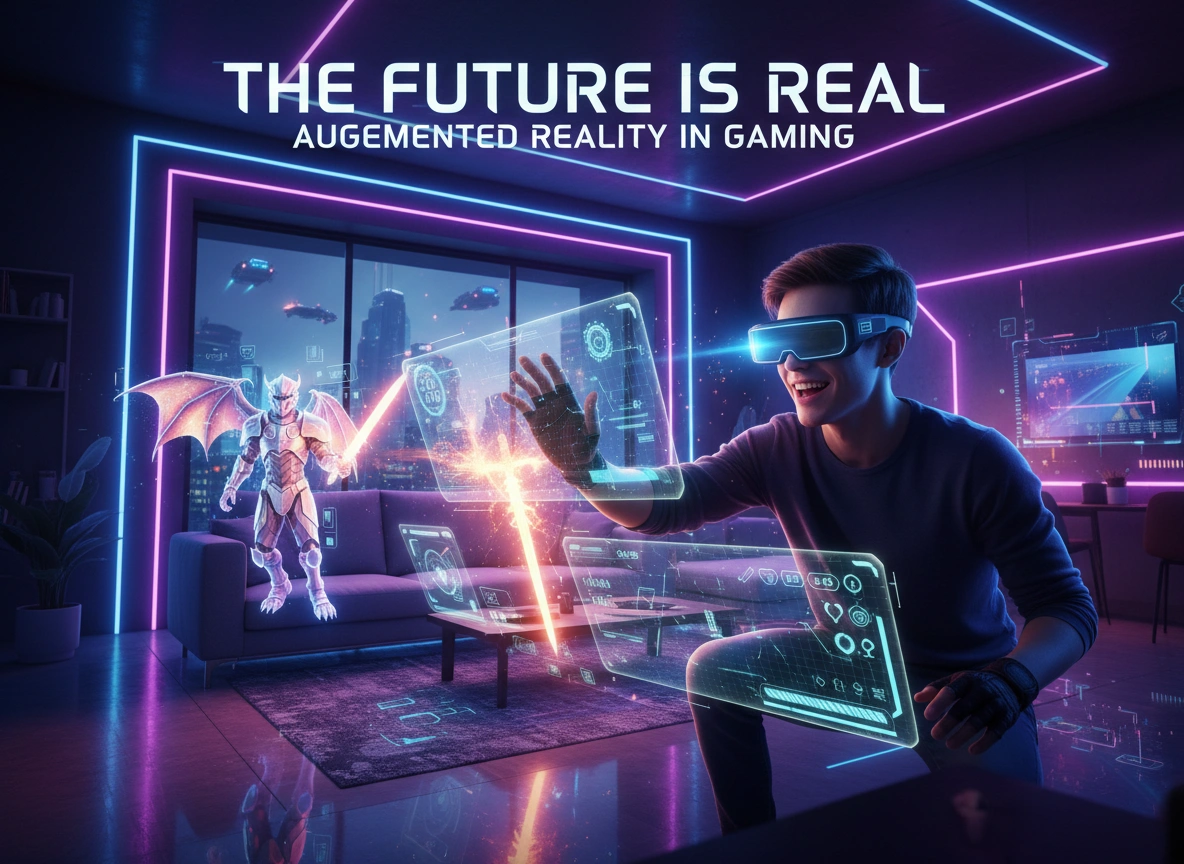
Augmented reality (AR) is reshaping how we interact with digital content by overlaying it onto our physical world. Unlike virtual reality (VR), which creates a completely artificial environment, AR enhances our existing reality. This technology uses devices like smartphones, tablets, or specialized glasses to project computer-generated images, sounds, and information into our line of sight, creating an interactive and composite view. The core principle is to blend the digital and physical worlds so seamlessly that they appear to coexist.
This fusion of realities opens up incredible possibilities for the gaming industry. By turning everyday spaces into dynamic playgrounds, AR offers a new dimension of immersion and interaction that traditional screen-based gaming cannot match. This article explores the potential of augmented reality in gaming, from its early days to its promising future, examining the benefits, challenges, and innovations that are shaping this exciting frontier.
The Evolution of AR in Gaming
Augmented reality gaming is not a new concept, but recent technological advancements have brought it into the mainstream. The journey has been marked by key milestones and pioneering games that demonstrated the potential of blending digital gameplay with the real world.
Early Concepts and Milestones
The idea of AR in gaming traces back several decades, but one of the first notable examples was the ARQuake project in the early 2000s. This experimental game modified the popular first-person shooter Quake to be played outdoors. Players wore a head-mounted display, a GPS unit, and a laptop in a backpack, allowing them to see virtual monsters appearing in their real-world surroundings. While cumbersome and inaccessible to the general public, ARQuake was a groundbreaking proof-of-concept.
For years, AR gaming remained largely in the realm of academic research and niche applications. The widespread adoption of smartphones equipped with powerful processors, high-resolution cameras, and GPS capabilities was the catalyst that brought AR to the masses. These devices provided an accessible platform for developers to create AR experiences without requiring expensive, specialized hardware.
The Rise of Mobile AR Gaming
The true turning point for AR gaming arrived in 2016 with the launch of Pokémon GO. Developed by Niantic, the game used a smartphone’s GPS and camera to allow players to find, capture, and battle virtual Pokémon that appeared in their real-world locations. The game became a global phenomenon, attracting hundreds of millions of players and demonstrating the massive commercial potential of AR. Pokémon GO proved that AR could create shared social experiences, encouraging players to explore their communities and interact with one another.
Following the success of Pokémon GO, other major franchises entered the AR space. Harry Potter: Wizards Unite and Jurassic World Alive adopted similar location-based mechanics, allowing players to cast spells or collect dinosaurs in their neighborhoods. These games further refined the formula, introducing more complex gameplay elements and narrative structures, solidifying mobile AR as a viable and popular gaming genre.
The Benefits of AR in Gaming
Augmented reality offers a unique set of advantages that can transform the gaming experience. By breaking down the barrier between the player and the game, AR creates a level of engagement that is difficult to achieve with traditional formats.
Enhanced Immersion and Realism
AR’s greatest strength is its ability to make game elements feel tangible and present. When a virtual character stands in your living room or a puzzle appears on your coffee table, the experience becomes deeply personal and immersive. This blend of real and virtual worlds creates a powerful sense of presence, making the gameplay feel more immediate and impactful. Players are no longer just controlling an avatar on a screen; they are active participants in a game world that has merged with their own.
Unprecedented Interactivity
AR technology encourages physical interaction. Instead of just pressing buttons on a controller, players might need to physically walk around a virtual object to inspect it from all sides, move closer to see finer details, or even use hand gestures to manipulate game elements. This kinesthetic engagement makes gameplay more active and intuitive. Games like Angry Birds AR: Isle of Pigs allow players to place the classic piggy towers on any flat surface and physically walk around them to find the perfect angle for their shot, adding a new strategic layer to a familiar game.
Social Connectivity and Shared Experiences
Many AR games are designed to be played in the real world, which naturally fosters social interaction. Location-based games like Pokémon GO encourage players to meet at specific real-world locations, such as parks and landmarks, to participate in raids and community events. This transforms gaming from a solitary activity into a communal one. Furthermore, AR allows for co-located multiplayer experiences where multiple players can see and interact with the same virtual objects in a shared physical space, creating a digital-age version of a classic board game night.
Challenges and Limitations of AR Gaming
Despite its immense potential, AR gaming faces several significant hurdles that have slowed its widespread adoption. These challenges span technological, financial, and accessibility domains.
Technological and Hardware Constraints
The quality of an AR experience is heavily dependent on the hardware running it. While smartphones have become powerful, they still have limitations. Continuous use of the camera, GPS, and processor for AR applications drains battery life quickly. Moreover, holding up a phone for extended periods can be physically tiring and breaks immersion.
True, seamless AR will likely require lightweight, comfortable, and socially acceptable AR glasses. While companies like Meta, Apple, and Google are investing heavily in this area, consumer-ready AR glasses that meet performance, battery, and cost expectations are still in development. Until this hardware becomes mainstream, the full potential of AR gaming will be constrained by the form factor of the smartphone.
Financial and Development Costs
Creating high-quality AR games is a complex and expensive endeavor. It requires specialized skills in 3D modeling, computer vision, and spatial computing. The development costs can be significantly higher than those for traditional mobile games. This financial barrier can deter smaller studios from experimenting with the technology, leading to a market dominated by a few large players with deep pockets. Furthermore, the uncertain return on investment makes many developers hesitant to commit to large-scale AR projects.
Accessibility and Environmental Barriers
AR games that rely on outdoor, location-based gameplay face inherent accessibility challenges. Players with mobility issues, those living in rural areas with few points of interest, or those in unsafe neighborhoods may be unable to fully participate. Weather conditions can also impact the playability of outdoor games. For AR to be truly inclusive, developers must design experiences that are adaptable and can be enjoyed by people in a wide range of circumstances and physical environments.
The Future of Augmented Reality Gaming
The future of AR gaming is bright, with ongoing innovations in hardware, software, and artificial intelligence poised to overcome current limitations. These advancements promise to unlock new levels of realism, intelligence, and personalization in AR experiences.
Advancements in Hardware and Software
The next generation of AR hardware will move beyond the smartphone. Smart glasses will eventually offer a hands-free, always-on AR experience, making interactions with digital content feel more natural and continuous. Improvements in display technology, battery efficiency, and processing power will enable more complex and visually stunning AR games.
On the software side, development platforms like Niantic’s Lightship and Apple’s ARKit are becoming more sophisticated. These tools provide developers with advanced capabilities for real-time mapping, environmental understanding, and multiplayer networking. As these platforms evolve, creating persistent, shared AR worlds that multiple users can interact with simultaneously will become easier, paving the way for a true “AR metaverse.”
Integration with Artificial Intelligence
The fusion of AR and artificial intelligence (AI) will be a game-changer. AI can be used to create more intelligent and responsive non-player characters (NPCs) that can realistically interact with the player and their environment. An AI-powered virtual character could understand the layout of your room, react to real-world objects, and engage in natural, unscripted conversations. This will make AR worlds feel more alive and dynamic, blurring the lines between game and reality even further.
A Transformative Future Awaits
Augmented reality is set to fundamentally change the landscape of the gaming industry. By overlaying digital worlds onto our physical reality, AR offers a new paradigm for immersion, interactivity, and social connection. While significant challenges related to hardware, cost, and accessibility remain, the pace of innovation is rapid.
From the early days of bulky research projects to the global phenomenon of Pokémon GO, AR gaming has already shown its power to captivate millions. As technology continues to advance, we can expect experiences that are more seamless, intelligent, and integrated into our daily lives. The journey is just beginning, but AR holds the promise of transforming not only how we play games but how we perceive and interact with the world around us.
Please visit this website for more info
