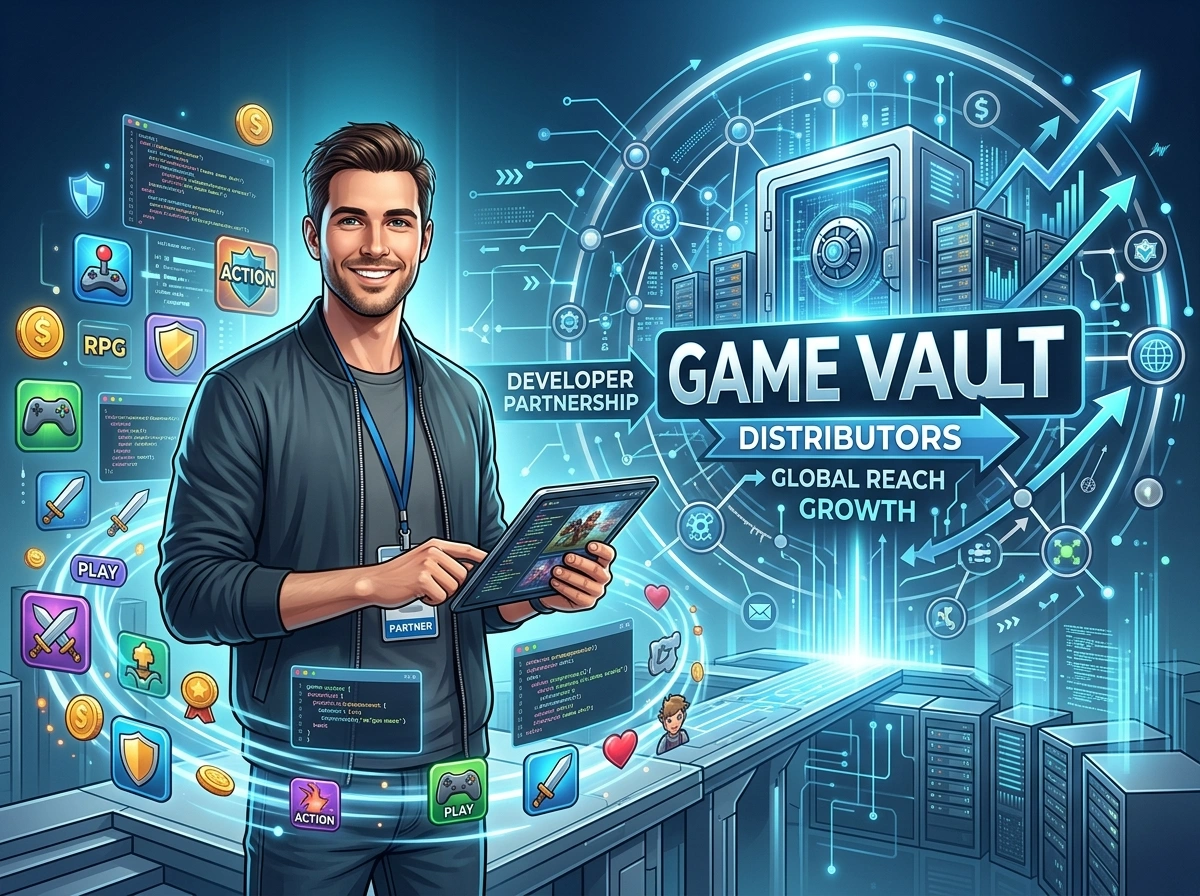
Game Vault distributors provide an essential decentralized marketing network for game developers. By handling player acquisition, local marketing, and credit management, these agents allow developers to focus entirely on game creation while scaling revenue in the rapidly growing sweepstakes gaming market.
Creating a high-quality game is only the first step in a successful software launch. Getting that game into the hands of paying players presents a completely different challenge. Traditional app stores often bury new releases under millions of competing titles, making organic discovery nearly impossible for independent studios.
Game creators face high platform fees, restrictive publishing guidelines, and rising user acquisition costs. To survive, developers need alternative distribution channels that actively push their products to engaged audiences. This demand has sparked a massive shift toward decentralized gaming networks and sweepstakes platforms.
Instead of relying on passive storefronts, developers can leverage active sales networks. By partnering with a Game Vault Distributor, creators tap into a dedicated team of store partners and agents who specialize in finding, onboarding, and retaining players.
This guide breaks down exactly why this distribution model works, how it changes the financial equation for developers, and what the future holds for decentralized game publishing.
How has the game distribution landscape changed for developers?
For years, game developers relied almost exclusively on centralized storefronts like Steam, the Apple App Store, and Google Play. These platforms provided essential infrastructure but extracted a steep price. Developers routinely surrender 30% of their gross revenue to these tech giants, often receiving very little marketing support in return.
As these traditional storefronts reached saturation, user acquisition costs skyrocketed. A developer might spend thousands of dollars on digital advertising just to secure a small handful of active players.
Recently, the market shifted toward specialized platforms and alternative regulatory models, such as the sweepstakes gaming industry. A 2024 industry primer by KPMG highlights that sweepstakes casinos have rapidly evolved, offering a highly lucrative alternative to traditional online gaming. These platforms operate on a unique legal framework, using dual-currency systems that require specialized distribution networks.
Game Vault emerged as a leader in this space. Instead of a centralized storefront, the Game Vault platform relies on a vast network of independent agents. These distributors operate as localized business owners, actively marketing games to their specific communities. For developers, this represents a shift from passive listing to active, incentivized promotion.
What are the strategic benefits of partnering with Game Vault distributors?
The most significant advantage of the agent-based distribution model is the clear division of labor. Developers excel at writing code, designing mechanics, and balancing gameplay. They rarely excel at customer service, grassroots marketing, or retail credit management.
Game Vault distributors take over the entire customer-facing operation. Choose this decentralized distribution model if minimizing overhead marketing costs matters more to your studio than retaining direct control over end-user relationships.
When a developer integrates their game into the Game Vault ecosystem, they instantly gain access to an army of motivated salespeople. Distributors earn their profit through margin spreads on game credits, meaning their financial success directly aligns with the game’s popularity. They have a vested interest in teaching players how to use the software, keeping them engaged, and resolving any technical issues immediately.
How do Game Vault distributors streamline user acquisition?
Customer acquisition in the mobile gaming sector is notoriously expensive. Distributors bypass traditional digital advertising bidding wars by utilizing localized, direct-to-consumer marketing strategies.
Game Vault equips its agents with comprehensive marketing packs. These include high-quality banners, social media assets, and promotional videos. Distributors use these tools to recruit players through channels developers typically cannot scale, such as localized Facebook groups, Telegram channels, WhatsApp networks, and physical internet cafes.
Because agents handle the onboarding process, developers do not need to build complex user registration funnels. The distributor creates the player accounts, loads the initial credits, and provides the first line of customer support. This localized touch drastically improves conversion rates. Players are much more likely to try a new game when recommended by a trusted local agent rather than a random internet advertisement.
How does the Game Vault platform drive monetization and revenue growth?
Monetizing a game through traditional channels often involves complex microtransactions, unpredictable ad revenue, or high-friction paywalls. The Game Vault model simplifies this through a centralized B2B credit system.
Developers provide the software, while Game Vault administrators distribute digital credits to wholesale agents. These agents then sell the credits to individual players at retail value.
This structure provides developers with highly predictable revenue streams. Instead of tracking pennies from thousands of individual microtransactions, developers benefit from bulk usage metrics across the platform. The platform’s industry-leading margins and flexible credit packages ensure that agents remain highly motivated to push volume.
Furthermore, because agents manage the actual payment processing through peer-to-peer applications or local cash transactions, developers avoid the high chargeback rates and merchant processing fees associated with traditional credit card payments.
What technical integration support does Game Vault provide developers?
A distribution network is only useful if the technical integration is seamless. Game Vault provides robust infrastructure designed specifically to support high-volume HTML5 and WebGL games.
Developers gain access to advanced agent management tools and backend APIs. These systems track player metrics, session lengths, and credit usage in real-time. The Game Vault platform handles the heavy database management, allowing developers to focus on optimizing game performance and deploying updates.
When a studio decides to partner with the network, the onboarding process is remarkably fast. Game Vault offers a streamlined setup process with instant account configuration. Developers can push their games live to the network without waiting through the weeks-long review processes typical of major app stores.
How do Game Vault agents enhance security and fair play?
Security remains a primary concern in any gaming environment involving digital credits. Developers must protect their software from exploits, while platforms must ensure fair play to maintain player trust.
The distributor model adds a unique layer of security. Because Game Vault agents manage their specific player rosters through an advanced dashboard, they can easily spot irregular betting patterns or suspicious account behavior. Agents act as a decentralized security force, quickly flagging bad actors to protect their own profit margins.
Game Vault also provides verified support teams available 24/7. If a developer notices a vulnerability or a server issue, they have direct access to priority agent support. This closed-loop ecosystem ensures that updates and security patches deploy instantly across the entire network, neutralizing threats before they impact the broader player base.
What is the real-world impact of decentralized gaming networks?
The sweepstakes and alternative gaming market is currently experiencing explosive growth. By moving away from overcrowded app stores, developers are finding highly engaged audiences with robust lifetime values (LTV).
Consider the mechanics of player retention. In a standard mobile game, a player might uninstall the app after a single frustrating loss or a minor bug. In the Game Vault ecosystem, the local distributor actively manages player retention. If a player goes dormant, the agent might offer a personalized promotion or free credits to bring them back.
This human element in player management routinely yields retention rates that far exceed algorithmic push notifications. Developers benefit from a stable, returning player base that consistently consumes their content, providing the financial stability needed to fund future projects.
What are the future trends in decentralized game distribution?
The future of game publishing leans heavily toward alternative networks. As regulatory environments shift and traditional app stores face antitrust scrutiny globally, developers will increasingly seek platforms that offer better revenue splits and active marketing support.
We expect to see integration of advanced AI analytics within agent dashboards. Game Vault distributors will soon have access to predictive models that highlight exactly which players are likely to churn, allowing for hyper-targeted retention strategies.
Additionally, mobile-first growth will continue to dominate. Players demand high-definition, responsive games that run flawlessly on standard smartphones without requiring massive downloads. Developers who optimize their titles for fast, browser-based delivery will thrive in the Game Vault ecosystem.
Take the next step in your game development journey
Relying on hope and algorithms is not a sustainable business strategy for game developers. To achieve consistent growth, studios must actively align themselves with platforms that incentivize user acquisition and provide reliable monetization frameworks.
Game Vault offers a comprehensive ecosystem where developers build, and agents sell. By offloading marketing, customer service, and credit management to a network of dedicated professionals, creators regain the time and resources necessary to do what they do best: make great games.
If your studio is ready to bypass traditional storefront fees and tap into a highly motivated sales network, research the technical requirements for Game Vault integration. Review your current portfolio to identify HTML5 or WebGL titles that fit the sweepstakes demographic. Finally, connect with the platform’s support team to discuss deployment timelines and revenue sharing models.
Frequently asked questions about Game Vault distributors
How much does it cost developers to use Game Vault distributors?
Developers do not pay upfront fees to agents. Instead, the platform operates on a revenue-share model based on credit consumption. The platform takes a percentage of the volume, and distributors earn their profits by marking up wholesale credits to retail players.
What is the timeline for integrating a game into the Game Vault platform?
Integration timelines depend on the technical readiness of your game. For fully optimized HTML5 games with standard API architecture, deployment can occur within a few days. The platform’s streamlined onboarding process eliminates the lengthy review periods found on traditional app stores.
Are there alternatives to the Game Vault distribution model?
Yes. Developers can self-publish on centralized platforms like Apple or Steam, partner with traditional game publishers who take a large percentage of IP rights, or utilize web-based portals like Kongregate. Choose the agent-based model if you specifically want localized marketing and lower payment processing friction.
Who is the Game Vault platform best suited for?
This platform is ideal for independent studios and developers creating high-definition slots, sweepstakes titles, fish games, and casual betting experiences optimized for mobile devices. It is less suited for large-scale AAA console developers.
What are the risks of using decentralized game distributors?
The primary risk involves brand control. Because independent agents handle player communication and local marketing, developers cannot tightly control the exact messaging used to promote their games. Developers must trust the platform’s agent guidelines and compliance monitoring to ensure quality representation.
