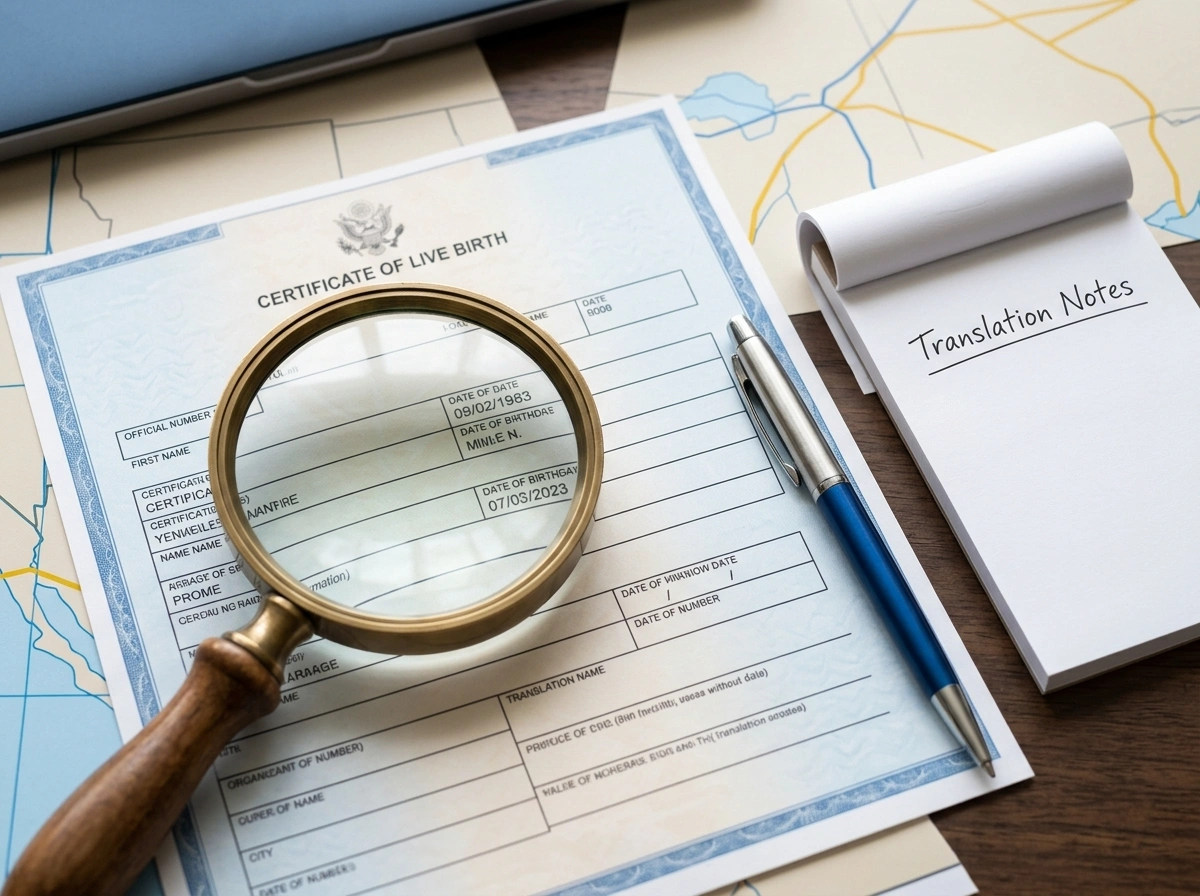
When you need an official document translated for immigration, school enrollment, or legal proceedings, your first instinct is likely to open a search engine and type a quick query. Finding a local business feels comforting and convenient. You want to drop off your paperwork, speak to a human being, and pick up the finished product a few days later.
Searching for a nearby provider makes perfect sense for dry cleaning or coffee. However, applying this same logic to official legal documents can lead to significant problems. A birth certificate is a critical foundational document. Errors, missing certifications, or formatting issues can result in rejected applications, delayed court dates, and severe financial headaches.
Many applicants assume that any local bilingual individual or neighborhood notary can handle a certified translation. This assumption regularly causes USCIS rejections and missed university deadlines. Professional translation requires specific formatting, industry-standard certifications, and linguistic precision that an average local print shop simply cannot provide.
This guide explores the common pitfalls applicants face when relying solely on location-based searches for document translation. We will examine why proximity should not be your primary deciding factor and outline the necessary steps to secure a flawless, legally compliant translation.
Understanding the “Near Me” Trap for Legal Documents
The search phrase “birth certificate translation near me” heavily skews search results toward physical proximity rather than professional competence. Search algorithms prioritize businesses with storefronts within a few miles of your current location. Consequently, the top results might include local tax preparers, neighborhood notaries, or general administrative service shops that offer translation as a side hustle.
These local storefronts often outsource the actual translation work to unvetted freelancers. Alternatively, they might use bilingual staff members who lack formal translation training. While these individuals speak two languages, they usually do not understand the strict legal requirements for formatting and certifying official documents.
Legal and immigration authorities maintain rigorous standards for foreign-language documents. A birth certificate contains highly specific terminology, regional seals, and bureaucratic stamps. Misinterpreting a single stamp or incorrectly formatting the layout can render the entire document invalid. When you prioritize a nearby location over specialized expertise, you expose your most important applications to unnecessary risk.
Common Mistake #1: Prioritizing Proximity Over Certification
Choosing a translator simply because their office is down the street is a critical error. Proximity does not equal qualification. A certified translation is a specific legal product. It must include a signed statement from the translator or translation company affirming the document’s accuracy and the translator’s competence.
Many local shops will translate your document and simply notarize the signature. However, a notary public only verifies the identity of the person signing the document. The notary does not verify the accuracy of the translation itself. If the local provider does not provide a formal Certificate of Accuracy that meets federal standards, your document will be rejected by immigration officials and universities.
You should always verify that the provider specializes in certified translations. They need to be familiar with the exact phrasing required by government agencies. A highly qualified online service on the other side of the country will serve you much better than an unqualified notary located on your street.
Common Mistake #2: Ignoring USCIS and Legal Requirements
The United States Citizenship and Immigration Services (USCIS) has strict, unwavering rules for foreign document translation. Under federal regulations, any document containing foreign language submitted to USCIS must be accompanied by a full English translation. The translator must certify that the translation is complete and accurate, and that they are competent to translate from the foreign language into English.
Local providers who do not specialize in immigration translation frequently miss these nuanced requirements. They might summarize sections of the birth certificate instead of providing a word-for-word translation. They might leave out the translation of government seals, watermarks, or border text. Any of these omissions will trigger a Request for Evidence (RFE) from USCIS.
An RFE stalls your immigration process for months. It causes immense stress and can jeopardize your legal status. To avoid this, you must use a provider with a proven track record of USCIS acceptance. They understand that every stamp, signature, and annotation must be meticulously translated and formatted to mirror the original document.
Common Mistake #3: Overlooking Industry-Specific Expertise
Translating a birth certificate involves more than swapping words from one language to another. Different countries use different legal frameworks, administrative structures, and naming conventions. A birth certificate from rural Mexico looks vastly different from a birth registration issued in Seoul or a family registry from Tokyo.
An ordinary local translator might struggle with the specific bureaucratic terminology used in these foreign registries. They might misinterpret cultural naming conventions, such as paternal and maternal surnames, leading to name discrepancies on your US legal documents. Name discrepancies are notoriously difficult to correct once entered into official databases.
Professional translation agencies employ linguists who specialize in specific regions and document types. They know how to handle complex civil registry terms accurately. If you need translation services los angeles or anywhere else with a highly diverse population, specialized expertise ensures your documents reflect your true legal identity without any localized misunderstandings.
Common Mistake #4: Falling for “Low Cost” vs. High Quality
When searching locally, you might find a neighborhood business offering translations for an unbelievably low price. Bargain-basement pricing is a massive red flag in the translation industry. High-quality, certified translation requires time, linguistic expertise, and a multi-step quality assurance process.
If a local provider charges a fraction of the market rate, they are cutting corners. They might be running your private documents through free, unsecure machine translation software and barely glancing at the output before handing it back to you. Machine translation struggles immensely with the formatting and complex syntax of official government certificates.
A cheap translation often ends up costing you significantly more in the long run. If your university application is rejected because of a flawed translation, you miss out on a semester. If your visa application is delayed, you might incur extra legal fees. Investing in a professional, reasonably priced service ensures the job is done right the first time.
Common Mistake #5: Not Verifying Confidentiality and Security
Birth certificates contain your most sensitive personally identifiable information. They list your full legal name, date of birth, place of birth, and your parents’ full names. Handing this document to a random local business without verifying their data security protocols is highly risky.
Small storefront operations frequently use unencrypted email networks to send documents back and forth to freelance translators. They might leave physical copies of your birth certificate lying on communal desks. They rarely have strict data retention and deletion policies in place to protect you from identity theft.
Professional translation companies prioritize data security. They use encrypted portals for document uploads. They require all their linguists to sign strict non-disclosure agreements (NDAs). After the project is complete and the retention period expires, they securely delete your personal data from their servers. Always ask a prospective translator how they protect your information before handing over your documents.
Why Online Certified Services Often Outperform Local Walk-ins
The digital transformation of the translation industry has made physical offices largely obsolete for this type of work. Online certified translation agencies typically offer superior service, better pricing, and faster turnaround times than local brick-and-mortar shops.
First, online agencies have access to a global network of specialized linguists. If you need a document translated from a rare dialect, a local shop will likely turn you away or deliver a subpar product. An online agency can instantly route your document to a vetted native speaker of that specific dialect.
Second, the process is incredibly streamlined. You do not need to take time out of your workday to drive to an office, find parking, and wait in line. You simply take a clear, high-resolution photo or scan of your birth certificate and upload it to a secure portal. The agency provides an exact quote, translates the document, adds the digital Certificate of Accuracy, and emails the PDF back to you. Digital certified translations are accepted by USCIS and most major universities.
How to Properly Vet a Translation Provider
Selecting the right translation partner guarantees a smooth application process. Instead of just searching for the closest provider, evaluate potential agencies based on their credentials and industry reputation.
Start by checking for membership in professional organizations, such as the American Translators Association (ATA). While membership does not guarantee perfection, it demonstrates a commitment to industry standards and professional ethics.
Read verified customer reviews focusing specifically on legal and immigration documents. Look for mentions of USCIS acceptance, formatting quality, and responsiveness. Ensure the company clearly states on their website that their translations meet federal immigration requirements. Finally, check their revision policy. A reputable agency will gladly correct any minor typos or formatting issues promptly and at no extra charge.
Ensuring Accuracy for Your Most Important Documents
Your birth certificate is the foundation of your legal identity. Securing an accurate, certified translation is a critical step in achieving your immigration, academic, or professional goals. Relying purely on a location-based search exposes you to unnecessary risks, subpar quality, and potential security breaches.
By understanding the strict requirements of government agencies and avoiding the allure of unqualified local shops, you can navigate this process with confidence. Prioritize specialized expertise, proven track records, and secure digital processes over physical proximity.
Take the time to research and choose a dedicated certified translation provider. Upload your document securely, review the certified translation carefully, and submit your applications knowing your paperwork meets every official standard.
