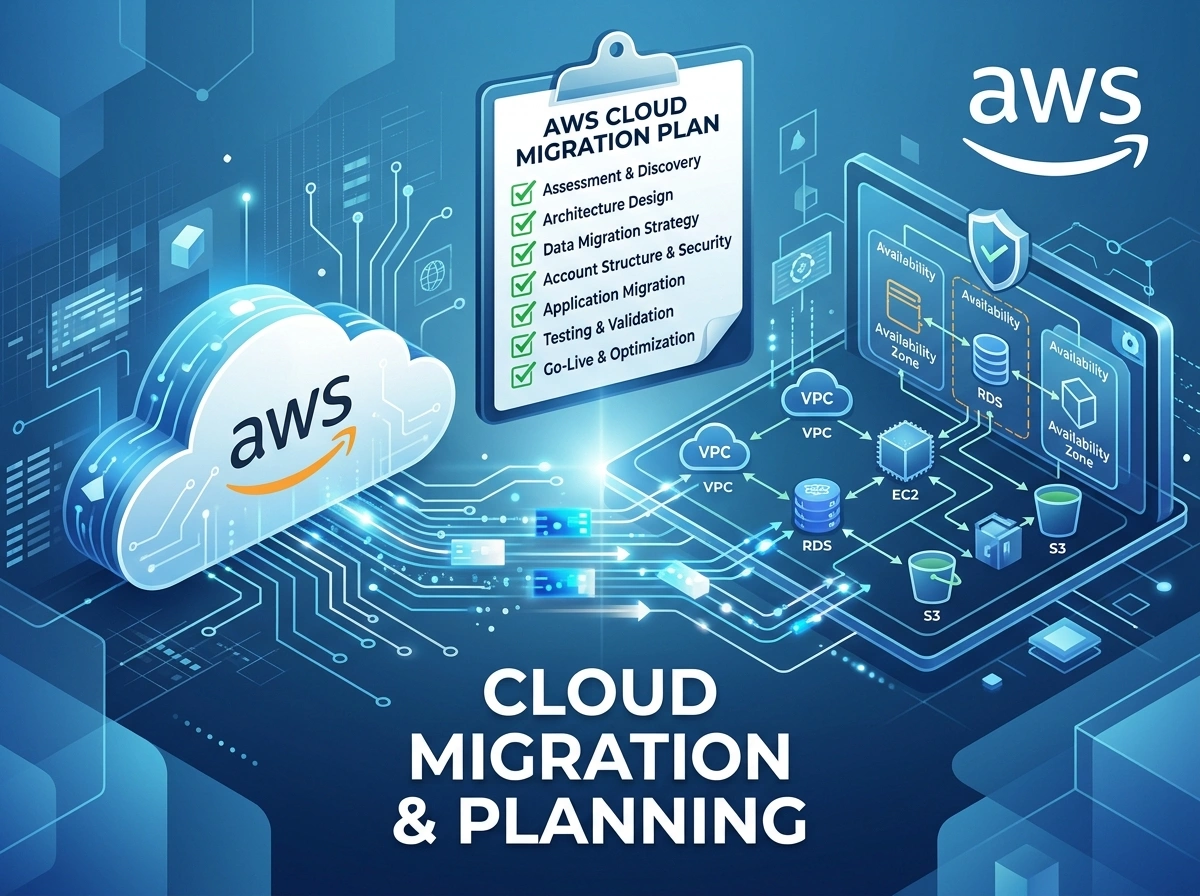
Moving your business to the cloud can feel like a giant leap. Servers, data, applications, and entire workflows all need a new home. When done right, the payoff is huge: lower costs, better scalability, and the freedom to grow without hardware headaches. When done poorly, you risk budget overruns, security gaps, and frustrated teams.
The secret to a successful migration isn’t the technology itself. It’s the planning you do before you spend a single dollar. Many organizations rush to buy resources and set up infrastructure, only to discover later that their approach didn’t match their actual needs. This guide walks you through the essential planning steps so your move to Amazon Web Services (AWS) is smooth, predictable, and cost-effective.
Why Planning Comes First
Think of cloud migration like building a house. You wouldn’t buy materials before you had blueprints. The same logic applies here. A clear plan helps you avoid wasted spending, prevents security oversights, and keeps your team aligned around shared goals.
AWS offers more than 200 services, ranging from compute and storage to machine learning and analytics. Without a roadmap, that variety becomes overwhelming. Planning narrows your focus to what your business genuinely needs, so you only pay for the services that deliver value.
Step 1: Assess Your Current Infrastructure
Before you can map out where you’re going, you need to understand where you stand today. Start with a full inventory of your existing systems. Document your servers, databases, applications, network setups, and storage. Note how each component performs and how they connect to one another.
Ask yourself a few key questions during this audit:
- Which applications are mission-critical, and which are rarely used?
- What are your current performance bottlenecks?
- How much data do you store, and how fast is it growing?
- Which systems have dependencies on others?
This assessment reveals what should move to the cloud first, what might need rebuilding, and what could be retired altogether. You may find legacy applications that no longer serve a purpose. Migration is a great moment to clean house.
Step 2: Define Clear Goals
Migration without goals is just movement. To get real value, you need to know what success looks like. Different organizations chase different outcomes. Some want to cut operating costs. Others need faster performance, stronger disaster recovery, or the ability to scale during busy seasons.
Write down your top three objectives and make them measurable. For example, “reduce infrastructure costs by 30% within 12 months” is far more useful than “save money.” These specific targets help you choose the right services and measure progress after the move.
Share these goals across your teams. When IT managers, engineers, and business leaders all understand the destination, decisions become easier and conflicts shrink.
Step 3: Build a Realistic Budget
Cost is often the biggest concern, and for good reason. The cloud’s pay-as-you-go model is flexible, but it can surprise you if you don’t plan carefully. Start by estimating your monthly usage based on your infrastructure assessment.
Factor in these costs:
- Compute resources such as EC2 instances
- Storage through services like S3 and EBS
- Data transfer fees, which many teams forget
- Support plans for technical help
- Migration tools and labor during the transition
AWS provides a pricing calculator to help you model these expenses. Build in a buffer of 15 to 20% for unexpected needs. Remember that the cloud lets you adjust spending over time, so your first estimate doesn’t have to be perfect. It just needs to be reasonable.
When you’re ready to set up your environment, you’ll need proper accounts to get started. Some teams choose to Buy Amazon AWS Accounts to streamline their onboarding and get up and running faster. Whatever route you take, make sure your account setup aligns with the budget and structure you’ve defined.
Step 4: Prioritize Security From Day One
Security can’t be an afterthought. The moment your data moves to the cloud, you take on shared responsibility with AWS. They secure the underlying infrastructure, while you handle access, configuration, and data protection.
Build your security plan around these basics:
- Identity and Access Management (IAM): Give users only the permissions they need, nothing more.
- Encryption: Protect data both in transit and at rest.
- Multi-factor authentication: Add an extra layer for account logins.
- Monitoring and logging: Use tools like CloudTrail and CloudWatch to track activity.
- Compliance: Map your setup to any regulations your industry requires, such as HIPAA or GDPR.
Decide on these policies before migration, not after. Retrofitting security is harder, slower, and riskier than building it in from the start.
Step 5: Choose the Right AWS Services
With your goals and budget in hand, you can now match your needs to specific AWS services. This is where the earlier planning pays off. Instead of guessing, you select tools that directly support your objectives.
A few common choices include:
- Amazon EC2 for scalable virtual servers
- Amazon S3 for reliable object storage
- Amazon RDS for managed databases
- AWS Lambda for serverless computing
- Amazon CloudFront for fast content delivery
Don’t try to adopt everything at once. Start with the core services that handle your most important workloads. You can expand later as your team grows comfortable and your needs evolve.
Step 6: Plan Your Onboarding Strategy
Technology is only half the battle. Your people need to be ready too. A strong onboarding plan helps your team adapt quickly and avoid costly mistakes.
Begin with a migration approach that fits your situation. The “lift and shift” method moves applications as-is, which is fast but may not optimize costs. Re-platforming makes small improvements during the move. Refactoring rebuilds applications to take full advantage of cloud features, which takes longer but delivers the best long-term results.
Train your staff on the AWS Management Console and the services you’ve chosen. Consider running a small pilot migration first. Moving one non-critical application lets you test your process, spot problems, and build confidence before tackling bigger workloads.
Finally, set up clear documentation and support channels. When questions arise, your team should know exactly where to find answers.
Bringing It All Together
A smooth cloud migration is the result of careful preparation, not luck. By assessing your current setup, defining clear goals, building a realistic budget, prioritizing security, choosing the right services, and planning onboarding, you set yourself up for a transition that strengthens your business rather than disrupting it.
The cloud rewards those who plan ahead. Take the time to map your journey before you commit resources, and you’ll avoid the common pitfalls that trip up rushed migrations. Whether you’re an IT manager, a business owner, or a cloud engineer, these steps give you a solid foundation to move forward with confidence.
Start with a clear plan today, and your migration to AWS will be simpler, safer, and far more successful tomorrow.
